Aviation (2)

Pilot News

Pilots, planes and aviation have been in the news a lot this year. Let’s go over the highlights:

Planes that crash just short of the runway in wintry conditions

Distracted pilots who overshoot their destination by 150 miles

A drunk pilot failing a breathalyzer test prior to a trans-oceanic flight from London

A flight landing on the taxiway instead of the runway at ATL

Air France flight 447 crashing into the Atlantic Ocean, killing all on board

It would be nice if there were more stories of successful “near misses” or “Miracles on the Hudson?” (well, obviously NO crash would be better, but if problems arise, I want my crew competent like Sully, Skiles, and their experienced flight crew) Crew payscales are ridiculously low compared to the last few years, and some crew members have resorted to living in an LAX airport parking lot.

But not all pilot news is bad. My favorite news is when I know that my husband is successfully assigned a non-rev or jumpseat and he’s on his way home (even if it means picking him up at 5 am). It’s been tough having him commute from Memphis, but I’m excited for the time DO get to spend with him. Even better is when he brings along my other favorite pilot for the ride. It can get a little zany with two pilots in the house, but it never feels more like home.

First Officer Jeffrey Skiles: Right Seat Hero

As the wife of a First Officer pilot, I’ve felt some disappointment about the reduced media bravado for First Officer Jeffrey Skiles. His role in the successful splash landing on the Hudson was just as vital as Captain Sully’s. A CA/FO relationship must be a well-oiled machine, as any pilot will tell you. “Pilot flying” and “pilot navigating” responsibilities are typically reversed on every leg of a trip. As I was looking for pictures to add to this posting, there were very few picture of Skiles alone. Most were taken with Sully, or with the flight crew.
I bring this up not to diminish the importance of a well-functioning flight crew, INCLUDING flight attendants. I wholeheartedly acknowledge the efforts of US Airways 1549 flight attendants Donna Dent, Sheila Dail and Doreen Welsh. They brilliantly followed the safety procedures to assist the 150 passengers to safety. My heart goes out to flight attendants in general, who must deal with unruly passengers and threatening situations in a big metal cylinder day after day.
I’m really glad that the media coverage post-accident has included the whole flight crew, but a little ticked off that the “FO got the shaft”(in the brilliant words of one of my FO friend). Yesterday, Skiles gave an excellent speech at the Committee on Transportation and Infrastructure, Subcommittee on Aviation, U.S. House of Representatives. Other than TV stations cutting Skiles off after Sully completed his remarks, the address in general was fantastic. Skiles echoed Sully in many of the issues found in US aviation. I will now quote part of his address.

Like each and every one of my fellow professional airline pilots and flight attendants, I realize that flying a commercial airliner is a tremendous responsibility. The aftermath of this incident has brought forth in me a renewed understanding that this is a job for experienced professionals. Being an airline flight crewmember, whether pilot or flight attendant, is a serious job for serious people, and I am tremendously proud to count myself among their number. The dedication, seriousness and professionalism with which we in the aviation community approach our responsibilities can be credited for the dramatic improvement of our national aviation safety record.

The training, procedures and tenets of cockpit resource management (CRM) developed throughout the airline industry over the last 15 years, played a significant role on January 15th. Training departments industry wide are ceaselessly striving to identify future problems and develop procedures to combat them before they occur. A functional self-disclosure safety program is a valuable tool to identify and track errors. Mutually agreeable solutions to make these programs available are in the traveling public’s interest. We must work tirelessly to maintain an unrivaled commitment to safety and professionalism. However, another component of the positive result was the vast experience of the cockpit AND cabin crew.

Sully and I have over 70 years of experience and 40,000 flying hours between us. New pilots in the jet aircraft of our affiliate airlines have 300 hours. When I began at US-Airways, the Company required several thousand hours just to gain an interview for a pilot position. It is certainly in the interest of the traveling public to have experienced crews in the cockpit.

Along with Captain Sullenberger, I have concerns for the future of the Airline Pilot Profession. Experienced crews in the cockpit eventually will be a thing of the past. What this country has experienced economically in the last 8 months, we have experienced in our industry for the last 8 years, since 9-11. In the wake of these 8 years of financial turmoil, bankruptcies, layoffs, and revolving door management teams, airline piloting careers have been shattered. I personally earn half of what I once earned, AND I have lost my retirement to a PBGC promise that will pay pennies on the dollar. Many pilots like Captain Sullenberger and myself have had to split their focus from the Airline Piloting Profession and develop alternative businesses or careers. I myself am a general contractor. For the last 6 years, I have worked 7 days a week between my two jobs just to maintain a middle class standard of living.

The more than thirty thousand people who work at US Airways are proud of the work they do each day, and of their accomplishments. To many of us, the near total devaluation of our professions by our management is heartfelt. In the last several years the only constant I see is the ever increasing compensation levels of our management.

When I started in this industry there were aviation dynasties. Entire families would be employed in aviation as pilots, flight attendants, mechanics or agents. An aviation career was something people aspired to their entire childhood, as I did. Now I know of NO ONE who encourages their children to enter the airline industry.

From our perspective, it is clear that the current state of the management/ labor negotiation process is broken. Negotiations drag out for years in stagnation with little clarity for those of us who have spent our entire lives training to be on the front lines of safety for the American flying public. We aren’t asking for special privileges, but for a level playing field inside the NMB negotiating process. There is not a balance in the negotiating process and the state of the airline piloting profession is proof.

I would respectfully urge members of this subcommittee to work with other relevant committees to promote better balance between airline management and airline employees, especially in the area of creating an environment for efficient and effective negotiations inside the National Mediation Board process, thereby eliminating years of negotiating stagnation. I believe the reforms being considered by the House Judiciary committee can lead to more cooperation and less confrontation. This in turn would certainly help to rebuild an environment that will allow us to concentrate on the safety of the traveling public.

Our colleagues in this industry have rallied around our incident. While Captain Sullenberger and I generally prefer to land at airports, we are proud that the Hudson River landing displayed what well trained, professional pilots and flight attendants can do when faced with tremendous adversity. We are all very gratified and moved that our colleagues in the flying industry have seen this incident as a positive reflection of themselves and our shared profession.

We must ensure that America’s proud aviation traditions of transporting our citizens with safety and security does not fall victim to the immense challenges we face. In this, Congress has a role to play. We hope that you will take seriously the challenges that aviation professional’s face by helping us to level the playing field, and working with us to protect the airline pilot profession.

We ask that congress be a partner to the men and woman who make up the professionals who move America every day, as well as the companies who employ us. Working together we can ensure that the flight crews of the future will be the best and the brightest, and will have the experience and training necessary to ensure safe air travel to each and every passenger they carry.

Amen, brother.

Wise Words from Sully

Oops! Wrong Sully!

There we go! US Airways Captain Chesley Sullenberger

Yesterday, Chesley Sullenberger, First Officer Jeffrey B. Skiles, and air traffic controller Patrick Harten received a standing ovation on Capitol Hill in Washington, Tuesday, Feb. 24, 2009, prior to testifying before the Committee on Transportation and Infrastructure, Subcommittee on Aviation, U.S. House of Representatives. In addition to further details of the emegency landing on the Hudson last month, he gave a grim but realistic explanation of the current aviation industry. Quoting his remarks:

I am not only proud of my crew, I am proud of my profession. Flying has been my life-long passion. I count myself fortunate to have spent my life in the profession I love, with colleagues whom I respect and admire. But, honorable Representatives, while I love my profession, I do not like what has happened to it. I would not be doing my duty if I did not report to you that I am deeply worried about its future.

Americans have been experiencing huge economic difficulties in recent months – but airline employees have been experiencing those challenges, and more, for the last 8 years! We have been hit by an economic tsunami. September 11, bankruptcies, fluctuating fuel prices, mergers, loss of pensions and revolving door management teams who have used airline employees as an ATM have left the people who work for airlines in the United States with extreme economic difficulties.

It is an incredible testament to the collective character, professionalism and dedication of my colleagues in the industry that they are still able to function at such a high level. It is my personal experience that my decision to remain in the profession I love has come at a great financial cost to me and my family. My pay has been cut 40%, my pension, like most airline pensions, has been terminated and replaced by a PBGC guarantee worth only pennies on the dollar

While airline pilots are by no means alone in our financial struggles – and I want to acknowledge how difficult it is for everyone right now – it is important to underscore that the terms of our employment have changed dramatically from when I began my career, leading to an untenable financial situation for pilots and their families. When my company offered pilots who had been laid off the chance to return to work, 60% refused. Members, I attempt to speak accurately and plainly, so please do not think I exaggerate when I say that I do not know a single professional airline pilot who wants his or her children to follow in their footsteps.

I am worried that the airline piloting profession will not be able to continue to attract the best and the brightest. The current experience and skills of our country’s professional airline pilots come from investments made years ago when we were able to attract the ambitious, talented people who now frequently seek lucrative professional careers. That past investment was an indispensible element in our commercial aviation infrastructure, vital to safe air travel and our country’s economy and security. If we do not sufficiently value the airline piloting profession and future pilots are less experienced and less skilled, it logically follows that we will see negative consequences to the flying public – and to our country.

We face remarkable challenges in our industry. In order to ensure economic security and an uncompromising approach to passenger safety, management must work with labor to bargain in good faith. We must find collective solutions that address the huge economic issues we face in recruiting and retaining the experienced and highly skilled professionals that the industry requires and that passenger safety demands. But further, we must develop and sustain an environment in every airline and aviation organization – a culture that balances the competing needs of accountability and learning. We must create and maintain the trust that is the absolutely essential element of a successful and sustainable safety reporting system to detect and correct deficiencies before they lead to an accident. We must not let the economic and financial pressures detract from a focus on constantly improving our safety measures and engaging in ongoing and comprehensive training. In aviation, the bottom line is that the single most important piece of safety equipment is an experienced, well-trained pilot.

Despite the bad economic news we’ve experienced in recent times – despite the many challenges we face as a country – I have faith in America, in our people, in our promise. I have briefly touched upon some major problems in my industry today – but I do not believe they are intractable, should we decide to work collectively to solve them.

We all have roles to play in this effort. Despite the economic turbulence hitting our industry, the airline companies must refocus their attention – and their resources – on the recruitment and retention of highly experienced and well-trained pilots, and make that a priority that is at least equal to their financial bottom line. Jeff and I, and our fellow pilots will fly planes and continue to upgrade our education and our training, while we attempt to provide for our families. Patrick and the other talented Air Traffic Controllers will continue to guide us safely through the skies, our passengers will spend their hard-earned money to pay for their travel, and our flight attendants, mechanics, ground crews, and administrative personnel will deal with the thousands of constant details and demands that keep our planes safely in the air.

You can help us, honorable Members of Congress, to work together across party lines, and can demand – or legislate – that labor, management, safety experts, educators, technical experts, and everyday Americans join together to find solutions to these problems. We all honor our responsibilities in good faith and with respect for one another. We must keep the American commercial aviation industry safe and affordable for passengers, and financially viable for those who work in the industry day to day. And for those talented young men and women considering what to do with their lives, we must restore the narrative of a compelling career path in aviation with sufficient economic resources to once again make this vision a reality.

Colgan 3407

On my usual too-early morning wake-up today, I quickly caught wind of the crash of a Dash 8 Q400 plane,Colgan flight 3407 – operating for Continental Connection. The plane crashed at 10:20 pm yesterday, 5 miles before their destination airport of Buffalo (which is an airport my husband has flown to many times.) The full report is here on CNN.

This crash, which killed 44 passengers, 4 crew, and one person on the ground comes only weeks after the U.S. Airways Miracle on the Hudson, where no fatalities occurred. For some reason, as “miraculous” as the U.S. Airways splash-landing was, I wasn’t as emotionally affected. I am glad that all passengers were safe, and the crew did a fabulous job in an emergency situation (which is why it annoys me that everyone calls it a miracle). But I think why I’m feeling so much sadness over the crash tonight is that it happened in the area of an airport my husband flies to, in a plane of similar capacity as my husband’s, with employees from a company my husband’s company owns (Pinnacle Airlines Corp purchaed Colgan Air in 2007, but don’t let me even start on that acquisition).

The causes of the accident will be under investigation by the NTSB for a while, so only speculation can be made at this point. I was reading the Aviatrix‘s take on the accident, which includes a trancript of the ATC recordings. She gives a much better summary of the situation than I ever could.

In less than a month we’ve seen the ultimate in triumph and defeat in the skies (within only a few hundred miles). My heart goes out to the families affected by the crash.

Addendum 2/19/09 : Some have misunderstood the intent of my comment about US Airways 1549 from my blog. I have read several news stories that have put a very strange spin on the story, which have made it seem that any other pilot, save Sully, would have caused a disastrous crash. This is not so. I know that my husband has received excellent safety training through his airline. He is nowhere near as experienced as Sully, but I have faith that MANY pilots in commercial aviation would have had the capacity to land the plane safely. The emergency procedures were expertly exectued, and I do believe God’s hand was active in the sucessful splash landing.

I’m absolutely pro-miracle, but I think credit does need to go overall to pilots who have safety procedures and flows so ingrained in their muscle memory that they would have the capacity to save lives. My husband was involved in a birdstrike that nearly required a belly landing, but he and the captain followed the safety requirements and successfully landed with no injury. Unfortunately, Colgan’s flight resulted in the worst case scenario…but I have faith that the pilots and crew members who perished were on top of their game – following safety procedures a best they could in an impossible situation.

Virgin Complaint


This letter, from a passenger of Virgin Atlantic, takes the cake of the best complaint letter ever filed. It’s even better than as my rant letters.

Fast Track to a jet pilot?


When something sounds too good to be true, it probably is. Especially in aviation.

I recently found out about the website www.jetuniversitysucks.com that airs out all the dirty laundry about Jet University, a flight school in Fort Lauderdale. They offer a jet transition program that will take you from your commercial pilot license (with multi-engine and instrument rating) to regional jet first officer in 4 months. You pay a lot of money up front($26,000-$70,000 depending on the program) to prepare for a guaranteed job interview with a regional airline. The splinter site talks of gross financial mismanagement and countless students that have been strung along without the contracted and promised results. There’s even a class-action lawsuit in the works for the pilots who have been taken advantage of by Jet U.

It’s true that some of the people who went through the program were successful, and are employed by the airlines as outlined (including my husband). For the others, I hope you are able to get the restitution you deserve.

My Favorite Aviation Commercial

When I lived in Utah, I spend four years in the semi-professional womens’ choir, Viva Voce. When I was in the choir, I sang one of my favorite pieces of choral music of all time: Adiemus from Songs of Sanctuary. I had heard it years before on this Delta Airlines Commercial, and was excited to learn it. This was before I even knew Taylor, let alone him starting his aviation career. I randomly found it on YouTube today. Pardon my French, but I actually understand what they’re saying.

Flaps Up!


This morning Taylor and I caught the early showing of Madagascar 2. The pilot penguins totally make the movie! From the “Flaps Up!” comment, to the union contract representative (“No maternity leave!”), you may catch yourself laughing so hard your eyes tear up….it happened for Taylor. I recommend this for the whole family, especially those that love aviation movies.

Birdstrikes!


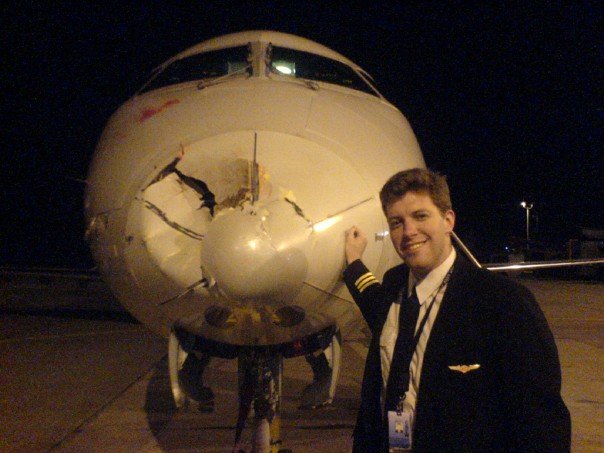
I was just reading about a birdstrike on a Ryanair flight in Rome today. Last November, on Taylor’s first trip off O.E., he had his first birdstrike. I blogged about it last year here, but its one of the aviation experiences that Taylor loves to retell. Of all my blog entries that get searched on Google, this experience has the highest search rate. A lot of pilot SO’s now read my blog, and I was curious how many of your pilots have experienced a birdstrike??

Here are some pictures from last years birdstrike incident…


Just for fun, here’s the story again:
(11/27/07) Yesterday was Taylor’s first flight out of O.E. training. He was on reserve for the day with a three-day trip planned for Tuesday. He got called in for a quick out-and-back to Wausau, Wisconsin. It was a cold, snowy day in Detroit…but after an hour and a half of delays and de-icing they took off no problem. But as they came in for the landing approach, Taylor and the captain saw a flash of birds. Within half a second, a group of ducks crashed into the plane. They lost control of the nose wheel door and lost hydraulic system 3. It smashed the radome, went through the nose cone, then the radar, then the bulkhead, ending up in the forward avionics bay. Warnings and error messages were flashing, and luckily they were able to get down the landing gear before the hydraulic system bled out. Passengers snapped pictures of the plane after deplaning on the tarmac. It was one of those “once in a career” moments…and it was on Taylor’s first flight out of training.